Monday, January 31, 2022

Will going out in the cold give you a cold?

Many of us have heard: “Don’t go outside without a coat; you’ll catch a cold.”

That’s not exactly true. As with many things, the reality is more complicated. Here’s the distinction: Being cold isn’t why you get a cold. But it is true that cold weather makes it easier to get the cold or flu. It is still too early to tell how weather impacts the COVID-19 virus, but scientists are starting to think it behaves differently than cold and flu viruses.

As an associate professor of nursing with a background in public health, I’m asked about this all the time. So here’s a look at what actually happens.

Many viruses, including rhinovirus – the usual culprit in the common cold – and influenza, remain infectious longer and replicate faster in colder temperatures. That’s why these viruses spread more easily in winter. Wearing a heavy coat won’t necessarily make a difference.

Two women outside during the winter.
The cold weather does have an impact on whether or not you catch a cold.
Spencer Platt via Getty Images

Virus transmission is easier when it’s cold

More specifically, cold weather can change the outer membrane of the influenza virus; it makes the membrane more solid and rubbery. Scientists believe that the rubbery coating makes person-to-person transmission of the virus easier.

It’s not just cold winter air that causes a problem. Air that is dry in addition to cold has been linked to flu outbreaks. A National Institutes of Health study suggests that dry winter air further helps the influenza virus to remain infectious longer.

How your immune system responds during cold weather also matters a great deal. Inhaling cold air may adversely affect the immune response in your respiratory tract, which makes it easier for viruses to take hold. That’s why wearing a scarf over your nose and mouth may help.

Also, most people get less sunlight in the winter. That is a problem because the Sun is a major source of vitamin D, which is essential for immune system health. Physical activity, another factor, also tends to drop during the winter. People are three times more likely to delay exercise in snowy or icy conditions.

Instead, people spend more time indoors. That usually means more close contact with others, which leads to disease spread. Respiratory viruses generally spread within a six-foot radius of an infected person. When you are indoors, it is very likely that you are closer together than six feet.

In addition, cold weather dries out your eyes and the mucous membranes in your nose and throat. Because viruses that cause colds and flu are typically inhaled, the virus can attach more easily to these impaired, dried-out passages.

A child in bed with a cold.
Spending more time indoors can increase the chances of catching a cold.
Rawpixel via Getty Images

What you can do

While the bottom line is that being wet and cold doesn’t make you sick, there are strategies to help prevent illness all year long.

  • Wash your hands often.
  • Avoid touching your face, something people do between nine and 23 times an hour.
  • Stay hydrated; eight glasses a day of water is a good goal, but that could be more or less depending on lifestyle and the size of the person.
  • Eat a well-balanced diet. Dark green, leafy vegetables are rich in immune system-supporting vitamins; eggs, fortified milk, salmon and tuna have vitamin D.
  • Stay physically active, even during the winter.
  • Clean the hard, high-touch surfaces in your home often.
  • If your nose or throat gets dry in the winter, consider using a humidifier.
  • Get the flu vaccine.

And one more important thing this year: When it’s your turn, make sure you get the COVID-19 vaccine.

[The Conversation’s most important coronavirus headlines, weekly in a new science newsletter.]The Conversation

Libby Richards, Associate Professor of Nursing, Purdue University

This article is republished from The Conversation under a Creative Commons license. Read the original article.

The post Will going out in the cold give you a cold? appeared first on MedShadow.


Original post here: Will going out in the cold give you a cold?

Friday, January 28, 2022

Can an Opioid Addiction Drug Treat Autoimmune Disorders?

Evidence is mounting that low doses of naltrexone can treat conditions like lupus and multiple sclerosis effectively and with few side effects.

A slew of drugs, both new and old, are used to treat autoimmune disorders like multiple sclerosis (MS), lupus and Crohn’s disease. Most of them come with side effects, some of them serious. But research and experience from patients and doctors are mounting that a drug used to treat substance abuse, when used in lower doses, can effectively treat autoimmune conditions with few side effects.

The drug is naltrexone, which was first approved in the 1980s to treat heroin addiction. In recent years, it has been prescribed more and more at a low dose for patients with autoimmune disorders. But is this off-label use (approved by the FDA for other conditions but not autoimmune disorders) safe and effective?

Proponents say low-dose naltrexone (LDN) is a treatment with few side effects that, for autoimmune patients, can help regulate the immune system (keeping it from behaving abnormally), provide pain relief and stop the body from attacking itself further.

How It Works

Naltrexone is an opioid antagonist, meaning it blocks the brain’s opioid receptors. Endorphins, the body’s “feel good” chemicals, bind to opioid receptors and give us a sense of calm. Drugs like heroin or opioid painkillers can also attach to these receptors, and they produce that same calming effect.

Naltrexone hasIt’s also been prescribed approved for alcohol addiction. Naltrexone keeps substances like heroin and alcohol from attaching to the brain’s opioid receptors, preventing users from getting high. That’s why it’s used to keep drug users in recovery from relapsing. LDN is thought to help reduce symptoms of autoimmune diseases because by partially blocking these receptors it helps to trigger the body’s production of endorphins.

The typical alcohol addiction treatment dose is 50 mg a day. For opioid addiction, an initial dose of 25 mg may be given and increased to 50 mg per day if no withdrawal signs occur with 25 mg. Adverse events include nausea and vomiting, headache, fatigue, dizziness, anxiety and joint pain.

Patient Experience

While some autoimmune patients who’ve taken LDN report no change at all in their health, and others note side effects like insomnia, vivid dreams or night sweats, others, like Darlene Nichols from St. Louis, report successes. Nichols was diagnosed with lupus in 1989, and later, myasthenia gravis.

She tried prednisone and other drugs typically prescribed for autoimmune conditions, “but they didn’t really work for me,” she said. “I had days where my legs would be so weak I couldn’t walk.” In 2009, she started taking 3.5 mg a day of LDN and then 4.5 mg.

“After two weeks, I was feeling great,” she said. “I had energy and strength, my fatigue disappeared. It’s like a miracle for me.” As for side effects, Nichols said initially her quality of sleep declined slightly, but soon returned to normal.

Other people with autoimmune diseases who’ve taken LDN point to decrease autoantibodies — antibodies that target healthy cells in autoimmune conditions — and an improvement in their pain.

No Significant Side Effects For Most

In a 2019 analysis published in BMC Medicine, researchers reviewed the results of 89 randomized trials on serious adverse events of naltrexone versus placebo. The studies included about 12,000 people with alcohol use disorder and other addictions, psychiatric disorders, obesity, Crohn’s disease, fibromyalgia, cancers and other conditions. The researchers concluded that naltrexone doesn’t increase the risk of serious adverse events over placebo.

Physicians prescribing LDN for autoimmune conditions typically give up to 4.5 mg to be taken before bed for peak effectiveness. Patients having vivid dreams, insomnia or night sweats, however, can take their dose in the morning instead.

The medication is popular with functional medicine doctors. Functional medicine aims to restore health by getting to the root cause of patients’ symptoms.

Ann Shippy, MD, an Austin, Texas, internist and functional medicine practitioner, has prescribed LDN for patients with a variety of autoimmune conditions for the last 10 years. “It can be helpful for a person’s general sense of well-being while we’re working on the root cause of getting the body repaired,” she said.

Some of her patients have found the medication to be “a game-changer,” she said, while some report no change in symptoms. Others have been very sensitive to it, she said, reporting vivid dreams. Intense dreams typically subside though, Shippy added, or improve on a lower dose. “I haven’t seen any significant side effects,” she said.

Since LDN is not approved by the FDA for any condition, it’s not commercially available. Patients must obtain a prescription from their physician and get the medication from a compounding pharmacy. Doctors advise finding a pharmacy familiar with making LDN to ensure they don’t compound a slow-release formula or add calcium carbonate as a filler, which can slow absorption.

An Immune System Regulator

In the mid-1980s — when naltrexone was approved for opioid addiction treatment — New York City physician Bernard Bihari found it could help patients with autoimmunity, cancer, HIV and AIDS when taken at low doses of around 3 mg.

Low doses only partly block opioid receptors at times when our endorphin levels are high, at around 3 a.m. or 4 a.m. That tells the brain our endorphin levels are low, prompting our brain to make more. It’s a mechanism that can theoretically help people with autoimmune conditions, who typically have lower levels of endorphins, which play a key role in regulating the immune system.

In treating HIV patients in the 1980s, “it wasn’t a home run,” said Ronald Hoffman, MD, an integrative medicine physician and medical nutritionist in New York City.

However, decades later, Hoffman has seen his patients with multiple sclerosis, Crohn’s disease and itchy, inflammatory skin conditions improve on LDN. He uses it in conjunction with lifestyle changes, including diet modifications and adding supplements. He now also prescribes LDN routinely for cancer patients.

Seemingly Safe, But More Research Needed on Efficacy

Research has shown LDN can reduce symptom severity in autoimmune conditions and some other syndromes marked by chronic pain, such as fibromyalgia.

A study in Digestive Diseases and Sciences found that 88% of participants with Crohn’s taking LDN saw an improvement in symptoms. But an in-depth analysis of those results determined that the evidence was insufficient to suggest the efficacy or safety of LDN for treating people with active Crohn’s disease. Studies of LDN for MS have been mixed, with one in the Multiple Sclerosis Journal showing no difference between MS participants taking LDN and those taking a placebo in terms of quality of life, and one in the Annals of Neurology showing improvement in mental health quality of life in people with MS.

A later, long-term study of LDN for MS concluded that “the apparently non-toxic, inexpensive, biotherapeutic is safe and if taken alone did not result in an exacerbation of disease symptoms.” Researchers call for more long-term studies to determine the usefulness of LDN for MS.

Research supports LDN for other major autoimmune conditions. A 2018study in the Journal of Translational Medicine showed that 74.5% of patients with inflammatory bowel disease treated with LDN showed an improvement in symptoms, and 25.5% went into remission.

In laboratory research, LDN appears to suppress inflammation in COVID-19, leading researchers to suggest that it has the potential to treat the disease, alone or in combination with antivirals. A pilot study comparing treatment with LDN to placebo treatment has begun recruiting participants who have recently tested positive for COVID-19. Researchers hope to have results by the end of 2021.

Meanwhile, pharmaceutical company Immune Therapeutics is in talks with the FDA about a clinical trial for its LDN-based drug Lodonal, which is currently being used abroad for various indications,  and has plans to study the drug for COVID-19.

New York-based internist David Gluck, MD, writes about LDN at his website www.lowdosenaltrexone.org, where physicians and patients report they’ve seen success in autoimmune conditions including Hashimoto’s disease, rheumatoid arthritis, ulcerative colitis, celiac, Sjogren’s syndrome and scleroderma. 

The post Can an Opioid Addiction Drug Treat Autoimmune Disorders? appeared first on MedShadow.


Original post here: Can an Opioid Addiction Drug Treat Autoimmune Disorders?

Tuesday, January 25, 2022

So You Test Positive for COVID-19, Now What?

When the pandemic first broke out in 2020, every COVID-19 treatment was experimental. Researchers tested existing drugs, like the antiparasitic Plaquenil (hydroxychloroquine) or the anti-inflammatory Ozurdex, Maxidex or others (dexamethasone), that they hoped could fight the virus or dampen damaging inflammation. Other medical personnel tried antidepressants on patients.  

Now, two years in, researchers and regulators have provided evidence-based guidelines for repurposing drugs and administering newly developed treatments to patients at high risk of, or who already are, experiencing severe disease. Read on to learn your options, if you test positive.

Immediately After Testing Positive:

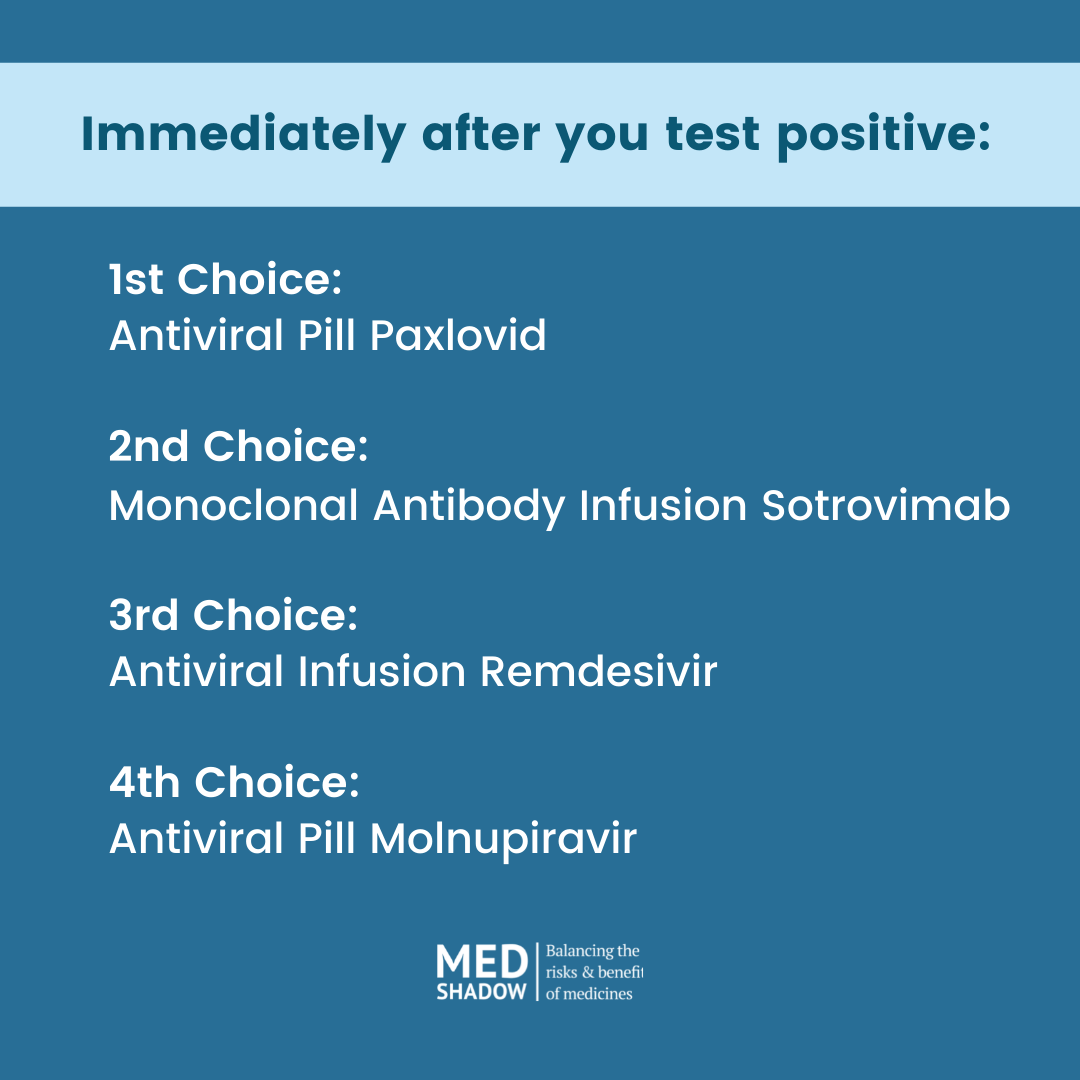
As the pandemic has continued, scientists have found several groups of people, such as those who are immunocompromised, have diabetes, hypertension or obesity, are at a higher risk for severe outcomes from COVID-19. If you are in that group and receive a positive test result, the National Institutes of Health (NIH) recommends the antiviral Paxlovid (nirmatrelvir, ritonavir) as your first option. If it’s unavailable or you can’t take it for another reason, the agency suggests Xerudy (sotrovimab), a monoclonal antibody. After that, it offers two other antiviral pills: Veklury (remdesivir) or Lagevrio (molnupiravir).

test positive

Which Antiviral Is Best 

The antiviral drugs, Paxlovid, Veklury  and Lagevrio are all designed to prevent the virus from replicating inside your body, so that the disease doesn’t worsen.

Veklury emerged early in the pandemic, but evidence of its efficacy was limited. It was only used on hospitalized patients. Recent data from the end of 2021 suggest that, if it’s administered within seven days of symptoms starting, it can keep 87% of high-risk patients out of the hospital. However, since it’s given intravenously, you need to have it administered at a hospital or clinic. The frequency is once a day for three days.

At the end of 2021, the Food and Drug Administration (FDA) authorized the two new antiviral drugs, available as pills you can pick up at a pharmacy and take at home.

Paxlovid is the clear drug of choice for the FDA. It decreased the chances of hospitalization by 89% in clinical trials, compared to Lagevrio’s 30% rate. Additionally, while Lagevrio is easier to take than Veklury, it comes with the worrisome potential of causing birth defects. These defects have not shown up in the trials with humans, but in animal models.

Still, Paxlovid does come with the disadvantage that it interacts with many medications you may have been prescribed. Be sure to ask your pharmacist about any drugs or supplements you already take, even if they’re over-the-counter (OTC).

One other reason you might be prescribed Lagevrio or Vekluryover Paxlovid, even if Paxlovid is your safest option, is that its availability is limited, and many patients have struggled to find it.

Monoclonal Antibodies 

Monoclonal antibodies—synthetically developed antibodies designed to target the virus—were some of the first treatments authorized to manage COVID-19 in 2020.

There are now three versions of monoclonal antibodies on the market: Eli Lillie’s Bamlanivimab plus etesevimab, Regen-COV (casirivimab plus imdevimab) and Xevudy (sotrovimab). Unfortunately, while all three were highly effective in that they prevented hospitalization in about 85% of patients early on, only Xevudy fights the Omicron variant, which as of late-January 2022 makes up more than 99.5% of COVID-19 cases in the US.

To get monoclonal antibodies, you need a prescription and must have it infused at either a hospital or medical facility. Because only one brand is effective against the Omicron variant, there is a shortage of them.

Side effects mainly include infusion-site reactions, such as redness or bruising, and allergic reactions that cause symptoms, like fevers, swelling and hives.

If Hospitalized, Know This 

If your illness is severe enough to require hospitalization, it’s likely that you have systemic inflammation. Doctors will likely recommend Decadron (dexamethasone) or another corticosteroid that will dampen your immune response. In some cases, they may add an interleukin (IL)-6 inhibitor, such as Actemra (tocilizumab).

Some other drugs that modulate immune activity, such as the antidepressant Luvox (fluvoxamine), are still being tested for COVID-19. Physicians are also likely to add blood thinners, such as heparin, to your regimen to help prevent dangerous clots from forming during treatment.

If you’re in critical care, you may need several of the previously mentioned therapeutics along with drugs to treat a variety of complications, such as bacterial pneumonia or renal failure.

The post So You Test Positive for COVID-19, Now What? appeared first on MedShadow.


Original post here: So You Test Positive for COVID-19, Now What?

An Expert Guide to Safer, Smarter, Supplement Use

On May 13th, MedShadow is hosting a live webinar with an integrative psychiatrist and a clinical pharmacist to answer the questions most sup...